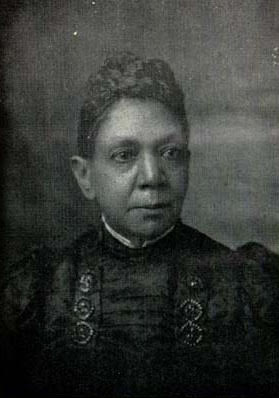
Fannie Jackson Coppin (1837-1913)


Fannie Jackson was born a slave in Washington D.C. on October 15, 1837.  She gained her freedom when her aunt was able to purchase her at the age of twelve.  Through her teen years Jackson worked as a servant for the author George Henry Calvert and in 1860 she enrolled at Oberlin College in Ohio.  Oberlin College was the first college in the United States to accepted both black and female students.

While attending Oberlin College Jackson enrolled and excelled in the men’s course of studies.  She was elected to the highly respected Young Ladies Literary Society and was the first African American student to be appointed in the College’s preparatory department.  As the Civil War came to an end she established a night school in Oberlin in order to educate freed slaves.

Upon her graduation in 1865, Jackson became a high school teacher at the Institute for Colored Youth, (ICY) a high school for African American students in Philadelphia.  Within a year she was promoted to principal of the Ladies Department and taught Greek, Latin, and Mathematics at the Institute.  In 1869 Jackson became principal of the entire institute, making her the first African American woman to receive the title of school principal, a position she would hold until 1906.

In addition to providing African American youth with education, Jackson founded homes for working and poor women. She also was an influential columnist who defended the rights of women and blacks in local Philadelphia newspapers.  Jackson added missionary work to her long list of accomplishments when she married Rev. Levi Jenkins Coppin, a minister in the African Methodist Episcopal (AME) Church on December 21, 1881.  In 1902 the couple went to South Africa and founded the Bethel Institute, a missionary school which emphasized self-help programs. After a decade of missionary work, Coppin returned to Philadelphia because of declining health. 

Fannie Jackson Coppin died in Philadelphia, Pennsylvania on January 21, 1913. She was 76 years of age.

In 1926, a Baltimore, Maryland teacher training school was named the Fanny Jackson Coppin Normal School in her memory.  It is now Coppin State University.

Comments

Popular posts from this blog

Pressure Points

Pressure points are vital points or weak points of the body where a blood vessel or a nerve is very close to the skin. Pressure on these points can cause pain, injury or even death if an atemi (blow) is applied. Only some martial arts as Hapkido, Aikido, Jujutsu, Karate, Kyusho Jutsu, and certain styles of Kung Fu include pressure points in their teachings. There are about 300 pressure points on the human body, but very few are used in martial arts. http:// www.martialartsdo.org/ articles/humanbody/ pressurepoints.php

PHYLLIS LINDA HYMAN (July 6, 1949 – June 30, 1995)

Phyllis Hyman was born in  Philadelphia ,  Pennsylvania , and grew up in  St. Clair Village , the  South Hills  section of  Pittsburgh . Born to an Italian mother, (Louise), and African-American father, (Phillip),  Hyman was the eldest of seven children. Through her paternal great-grandparents Ishmael and Cassandra (Cross) Hyman, she was also the first cousin once removed of actor  Earle Hyman  (best known for his recurring role on  The Cosby Show  as Cliff's father, Russell Huxtable). After leaving Pittsburgh, her music training started at a music school. On graduation, she performed on a national tour with the group New Direction in 1971. After the group disbanded, she joined All the People and worked with another local group, The Hondo Beat. At this time, she appeared in the film  Lenny  (1974). She also did a two-year stint leading a band called "Phyllis Hyman and the P/H Factor". She was discovered in 1975 by...

Elizabeth Key Grinstead (b. 1630 - d. c. after 1665)

Elizabeth Grimstead was one of the first women of  African  ancestry in the North American colonies to sue for her freedom from  slavery  and win. Elizabeth Key won her freedom and that of her infant son John Grinstead on July 21, 1656 in the colony of Virginia. She sued based on the fact that her father was an Englishman and that she was a  baptized   Christian . Based on these two factors, her English attorney and common-law husband William Grinstead argued successfully that she should be freed. The lawsuit in 1655 was one of the earliest " freedom suits " by a person of African ancestry in the English colonies. In response to Key's suit and other challenges, in 1662 the  Virginia House of Burgesses  passed a law that the status of children born in the colony would follow the status of the mother, "bond or free", rather than the father, as had been the precedent in English  common law  and was the case in England. This was the...